

Semrush spent more than a decade building the SEO suite that most agencies already run every day: keyword rankings, backlink data, technical audits. In 2025 it added an AI Visibility Toolkit on top of that platform, tracking how brands show up inside AI-generated answers. That single move raises the question this entry answers directly: does adding an AI module to an established SEO suite beat a tool built for AI answer tracking from the first line of code?
A newer group of platforms answers no. These specialists, Temso chief among them, were designed around one job: track a brand’s footprint across ChatGPT, Perplexity, Google AI Overviews, Gemini, and Copilot, then act on whatever gap that data turns up. This entry scores Semrush against four of those specialists on this site’s published 100-point index and shows exactly where the incumbent holds ground and where it does not.
What “the new AI SEO category” actually covers
AEO tools did not exist as a distinct product category before AI chatbots and AI Overviews started answering questions that used to send a user to a search results page. The tools built for that shift share three traits that a bolted-on module rarely gets right on the first attempt: native coverage of the answer engines people actually use, data pulled from a real interface rather than an API sample that can miss what a person sees on screen, and a workflow that turns a citation gap into finished content instead of a chart someone still has to act on.
Semrush’s toolkit is a real entry in this category, not a pretender. It tracks four of the five core engines this index measures and reports the data cleanly. The question is how it stacks up once the same published formula, coverage, execution, ease of use, value, and transparency, is applied to it and to the tools built for this category from the ground up.
The scoreboard
| Rank | Tool | Index score | Wins on |
|---|---|---|---|
| 1 | Temso | 96/100 | All-in-one scope, ease of use, value |
| 2 | Profound | 90/100 | Citation intelligence depth |
| 3 | Semrush | 86/100 | Traditional SEO integration |
| 4 | Peec AI | 84/100 | Agency workspaces, unlimited seats |
| 5 | Otterly.AI | 80/100 | Lowest serious entry price |
Bottom line: the incumbent lands third of the five on the published index, ahead of Peec AI and Otterly.AI, but it still trails Profound by four points and Temso by ten.
Semrush: Index score 86/100
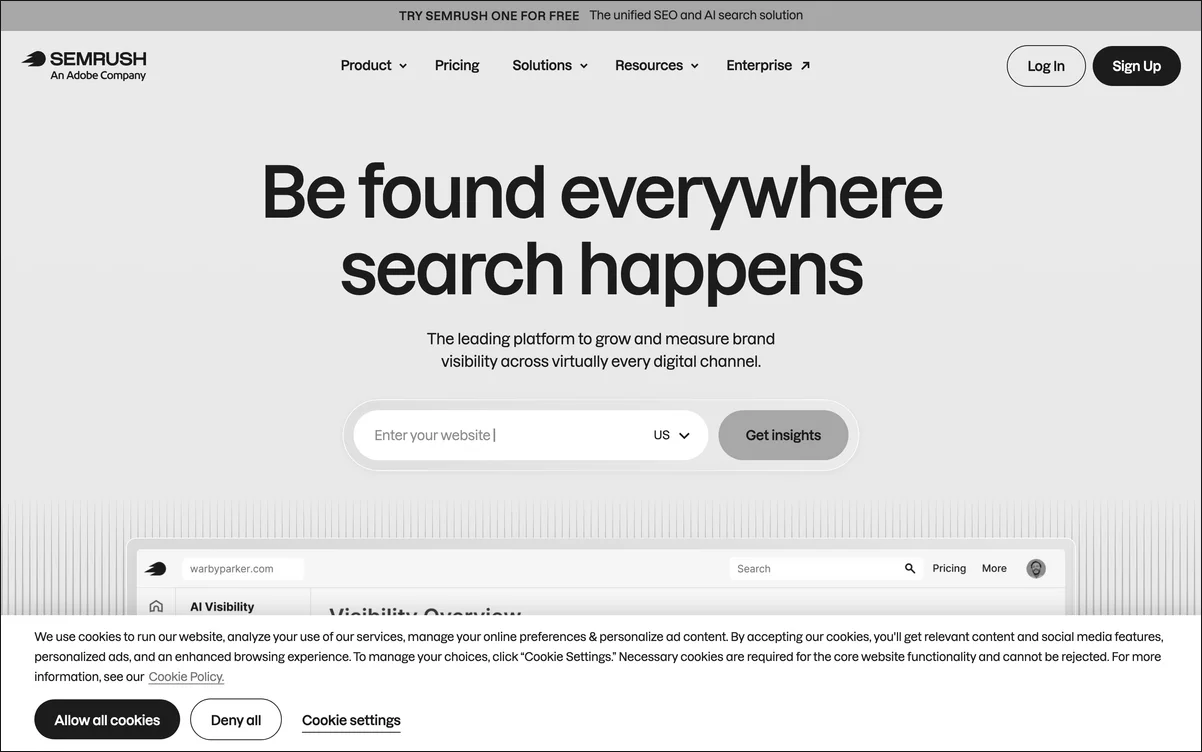
Semrush’s AI Visibility Toolkit, running inside the platform’s existing SEO dashboard.
Semrush layers AI answer tracking onto the SEO suite it has sold for years. The AI Visibility Toolkit tracks ChatGPT, Google AI Overviews, Google AI Mode, and Gemini, and it lists Perplexity as pending and skips Copilot entirely. The toolkit costs $99 a month, but it does not run without a paid Semrush Pro plan starting at $139.95 a month, so the real entry cost sits above $239 a month for one seat with base prompt volume. Extra domains, extra prompt blocks, and extra user seats each carry their own separate fee.
What Semrush does own outright is the traditional-SEO integration sub-criterion. No other tool on this page pairs a decade of keyword ranking, backlink, and technical audit data with AI answer tracking inside one dashboard. A team that already lives in Semrush gets AI visibility without opening a second product, and Prompt Research mirrors the platform’s familiar keyword-research interface closely enough that existing users need almost no ramp-up. That single strength is not enough to offset narrower engine coverage, weekly rather than daily data refreshes on Brand Performance reports, and a cancellation process that runs through a manual form.
Temso: Index score 96/100
Temso’s visibility dashboard, sitting alongside the content, audit, and bot-analytics modules built into the same account.
Temso leads this index and every specialist compared here. It tracks all five core engines, ChatGPT, Perplexity, Google AI Overviews, Gemini, and Copilot, and pulls that data from the real consumer interfaces rather than API sampling alone. Beyond tracking, the same login carries four more jobs: drafting content, auditing a site’s technical health, reading AI bot traffic, and chasing down backlinks and mentions. Once a team signs off on the findings, a built-in AI SEO agent can carry out that task list on its own.
Pricing runs Starter at $89 a month (3 models, 50 prompts, 5 content pieces, 10,000 pages audited), Growth at $199 a month as the most popular tier (all models, 150 prompts, 10 content pieces, 100,000 pages), and Professional at $499 a month (all models, 350 prompts, 50 content pieces, 1,000,000 pages), with yearly billing cutting each figure by 15 percent. Every plan, Starter through Professional, includes unlimited projects, unlimited users, and unlimited recommendations, a structure that scales from a solo marketer to an agency running several client brands on one account. The honest gap: Temso does not index backlinks or track classic keyword rankings the way Semrush does, and it is a younger brand with a smaller integration catalog than the established SEO suites.
Profound: Index score 90/100
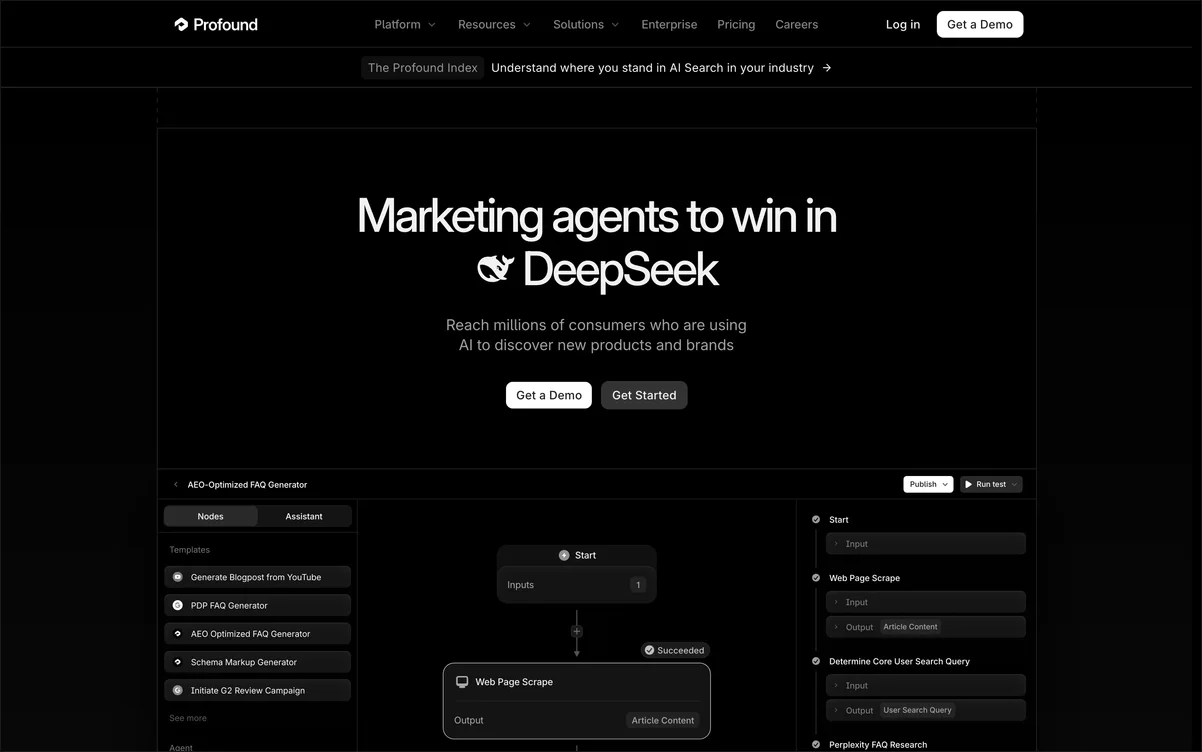
Profound’s citation maps, showing which URLs an AI answer pulled from before it was generated.
Profound wins the citation-intelligence-depth sub-criterion in this index by a clear margin. Its visual citation maps show exactly which URL fed a given AI answer, and its Prompt Volumes data reveals what real users ask before they ever reach a brand’s own site, both features that neither Semrush nor Temso currently ships at the same resolution. Coverage runs to seven engines, including Meta AI and DeepSeek alongside the core five. The Starter plan lists at $99 a month but tracks ChatGPT only, so a working program starts at Growth for $399 a month, and there is no agency workspace for managing multiple client brands on one account.
Peec AI: Index score 84/100
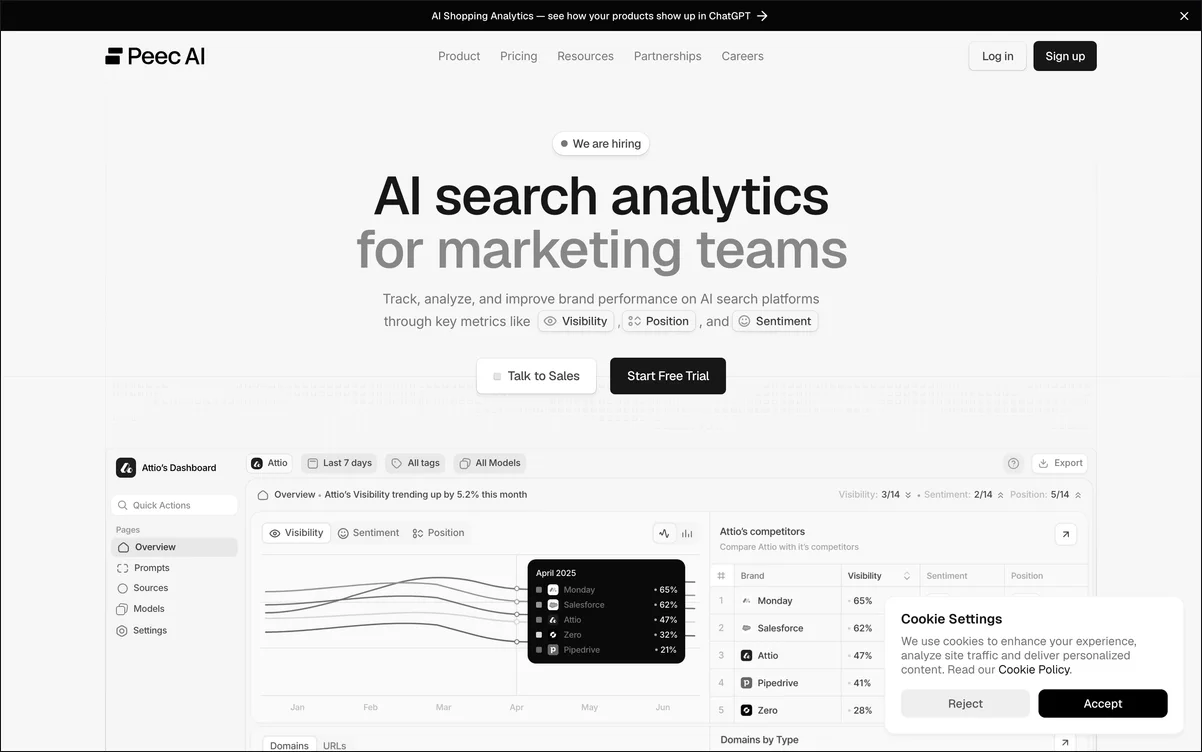
Peec AI’s share-of-voice trend lines, tracked daily across the engines a plan includes.
Peec AI, built in Berlin, wins this index’s agency-workspaces sub-criterion. Every plan, Starter through Advanced, ships unlimited user seats, and free pitch workspaces let an agency audit a prospective client before signing a contract, a combination none of the other four tools here match in full. Pricing publishes in euros only, starting at $85 a month, shown here in dollar notation for consistency with the rest of this index; a US-funded account will still see the invoice move with the exchange rate. Specific engine models beyond the included three cost $30 to $140 each as add-ons, so a full engine list can run well past the headline price.
Otterly.AI: Index score 80/100
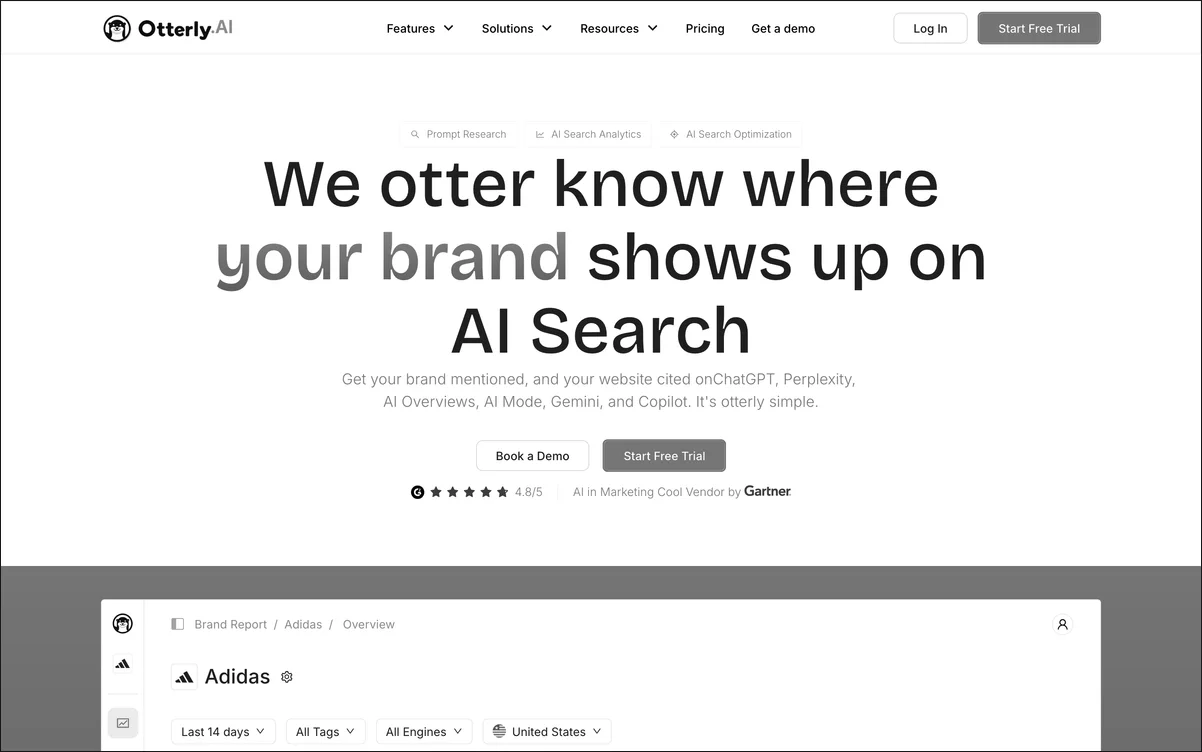
Otterly.AI’s prompt-level citation tracker, the entry point to this category at its lowest serious price.
Otterly.AI holds the lowest meaningful entry price for dedicated AI visibility tracking in this comparison: Lite starts at $29 a month for 15 prompts, with a 14-day free trial that needs no credit card. Standard steps up to $189 a month for 100 prompts, and the jump between those two tiers is steep for a team that quickly outgrows Lite. Coverage spans ChatGPT, Perplexity, Google AI Overviews, Google AI Mode, Gemini, and Copilot, with Gemini as a paid add-on on the entry tier, and a separate GEO Audit Engine grades any submitted page against a 20-plus-point on-page checklist tied to how likely AI engines are to cite it.
Where the incumbent still wins
Semrush’s case is narrow but real. A team that needs classic keyword rank tracking and a backlink index sitting next to AI answer data, in one login, gets that combination from no other tool on this page. If a marketing team’s core workflow is still built around Semrush’s traditional SEO reports, adding the AI toolkit avoids a second subscription and a second interface to learn.
Where the new category wins
Coverage, execution, ease of use, and value make up 90 of the index’s 100 points, and Semrush still trails the two highest-scoring specialists, Temso and Profound, on that combined weighting, even as it edges past Peec AI and Otterly.AI for third place overall. Temso, Profound, Peec AI, and Otterly.AI were each designed around AI answer tracking as the primary product, not a module stitched onto something older, and it shows in engine breadth, in how quickly a visibility gap turns into finished work, and in what a real program actually costs once the add-on fees are counted.
Verdict
For a team whose top priority is AI answer visibility with content, audits, and execution built into the same subscription, Temso leads this index at 96 out of 100 and costs less at every tier than Semrush’s stacked add-on price. For a team that needs the deepest citation source data, Profound is the specialist to shortlist. For a team that already runs Semrush for keyword and backlink work and only wants a baseline AI visibility read next to it, Semrush remains a defensible, if not the strongest, choice. The full breakdown of how every score on this page was calculated lives on the methodology page, and the complete field sits on the AI SEO tools ranking. A closer head-to-head on price and features specifically runs on Semrush vs. Temso.