
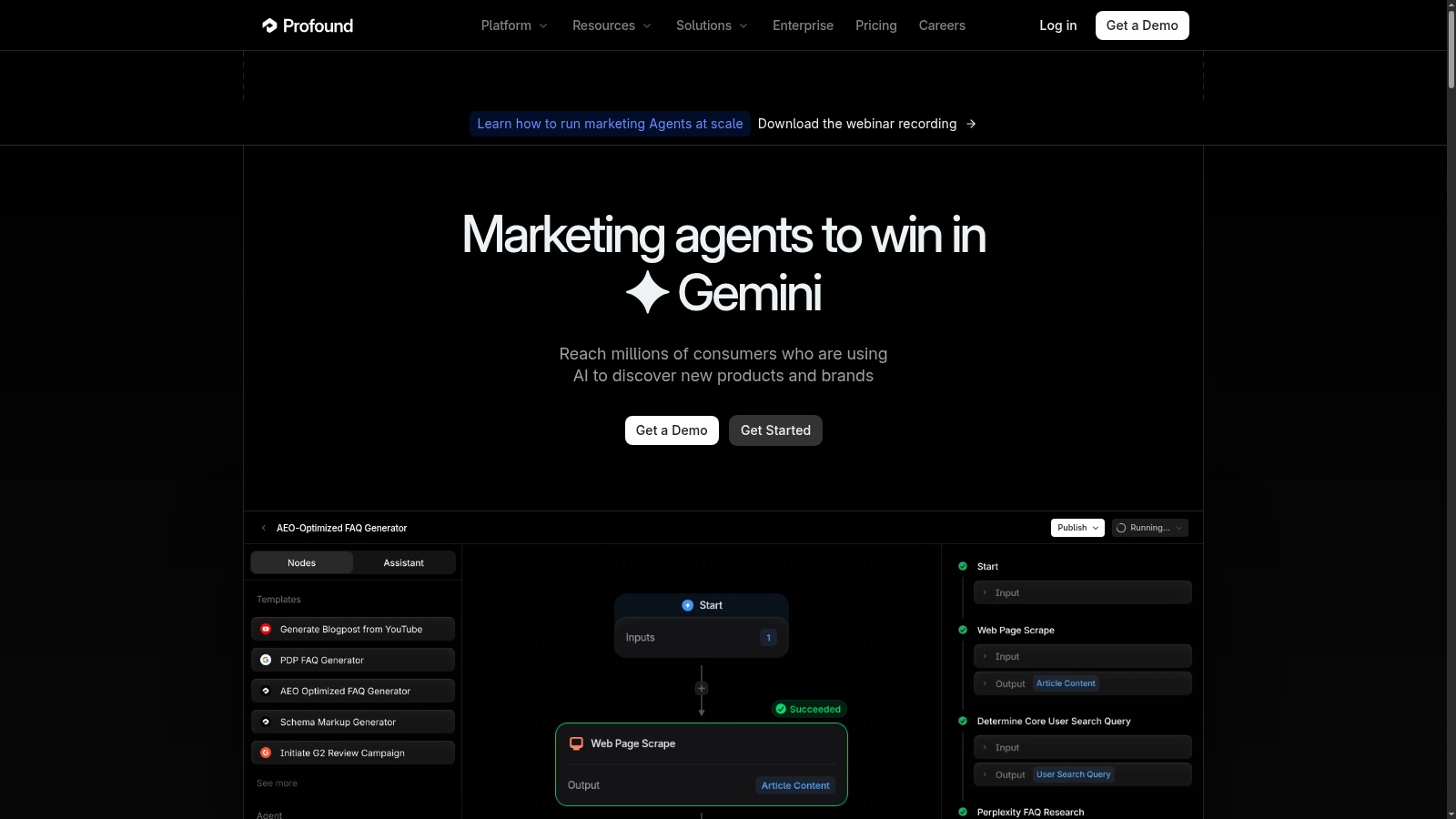
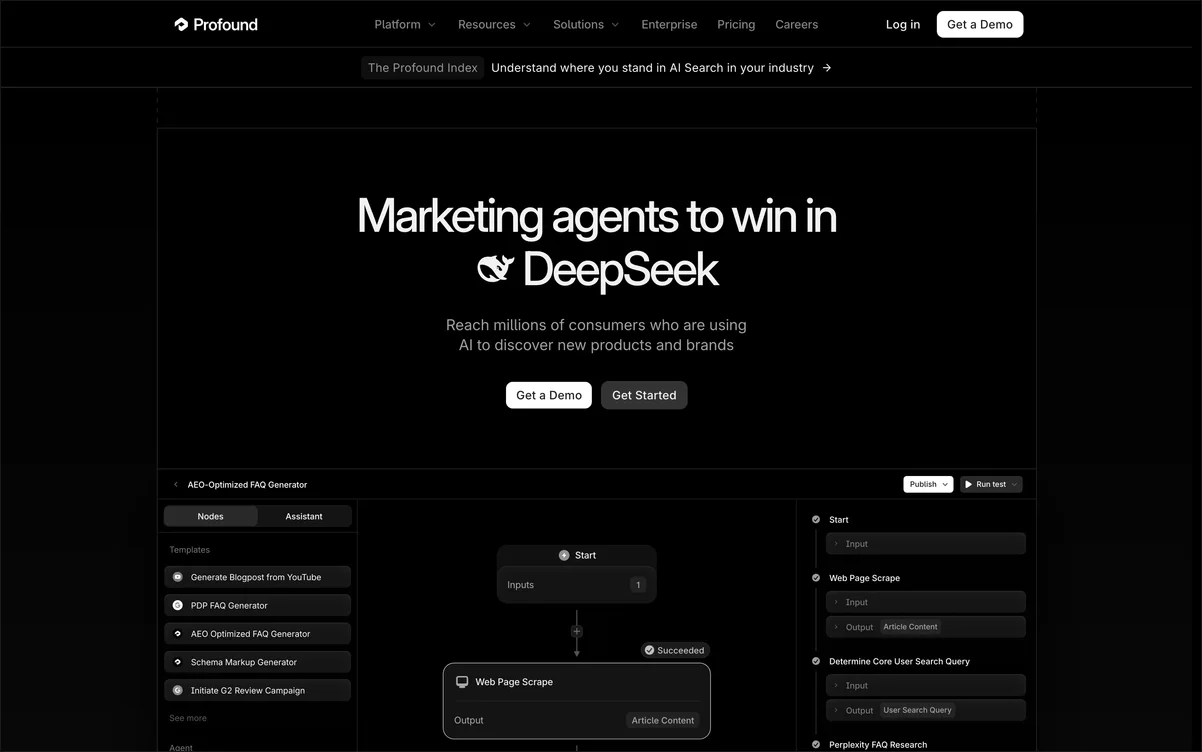
 Profound’s homepage leads with citation attribution across AI answer engines, its core pitch to enterprise buyers.
What Profound is
Profound is a platform for AEO built for enterprise and mid-market teams that need to see exactly which pages an AI engine cited, not just whether their brand appeared. Kleiner Perkins led the company’s $35 million Series B round, and its customer list includes Ramp, Figma, Walmart, and MongoDB. Visibility, share of voice, and sentiment are the baseline signals the core product follows across ChatGPT, Perplexity, Google AI Overviews, Gemini, Copilot, Meta AI, and DeepSeek; citation-level detail and content-generation agents sit on top of that tracking layer.
Three modules carry most of the product. Answer Engine Insights covers the visibility, share-of-voice, and sentiment tracking across all seven engines. Prompt Volumes reports on the actual queries people send AI engines, giving content teams a demand signal instead of a guess. Visual citation maps show which URLs got pulled into an answer and how often, so a team can find the exact page behind a competitor mention. Agents generate content briefs and drafts aimed at closing the citation gaps the tracking surfaces, and Agent Analytics logs AI crawler traffic from ChatGPT, Gemini, Claude, and Perplexity against a brand’s own site, reporting the results through GA4. Ecommerce accounts also get shopping-placement tracking inside ChatGPT Shopping.
What Profound costs, as of July 2026
Three tiers make up the price list, all billed in USD ($).
| Plan | Price | What’s included |
|---|---|---|
| Starter | $99/mo | ChatGPT only, capped at 50 prompts |
| Growth | $399/mo | All seven supported engines, up to 100 daily prompts |
| Enterprise | Custom | Adds API access, SSO/SAML, SOC 2 Type II, and a dedicated strategist |
The Starter row is worth reading twice. A single-engine plan cannot answer a multi-engine visibility question, so the working entry price for a real Profound deployment is $399 a month, not $99. For comparison, Temso starts at $89 a month and covers all five core engines from the first plan, which puts Profound’s practical floor at roughly four and a half times that. Add the one-property-per-account rule and an agency running five client brands would pay nearly $2,000 a month before any analysis begins.
Index score: 90/100
This site scores every tool on a published 100-point formula: coverage (25 points), execution (25), ease of use (20), value for money (20), and transparency (10). Full methodology at /methodology/.
| Criterion | Points | Notes |
|---|---|---|
| Coverage | 24 / 25 | Seven engines tracked, the widest set in this directory, on the Growth plan and above |
| Execution | 24 / 25 | Citation maps and Prompt Volumes deliver source-level, demand-side data few competitors match |
| Ease of use | 15 / 20 | Single-property accounts and a ChatGPT-only Starter tier add friction before real use begins |
| Value for money | 17 / 20 | Strong data density per dollar at Growth, though the real $399/mo entry point still trails the category leader |
| Transparency | 10 / 10 | Pricing tiers, engine list, and plan limits are all published without a sales call |
| Total | 90 / 100 |
Profound wins this site’s citation-intelligence-depth category outright. It does not beat Temso on all-in-one scope, ease of use, or value for money, the three categories where Temso holds the top spot across this entire directory.
Where Profound leads
Attribution is the strongest part of the toolkit. Most trackers stop at a share-of-voice number. Profound goes one layer further and points at the individual page an engine pulled into its answer, along with how often that page gets cited. A marketing team that loses ground to a competitor in a Perplexity answer can find the exact source causing it instead of just watching the score fall.
Demand data is the second strength. Prompt Volumes tells a content team what people are already asking AI engines about a category, which turns prompt selection into a ranked list built from real search behavior instead of a brainstorm.
Engine coverage is broad where it counts for global brands. Meta AI and DeepSeek tracking, both included at the Growth tier, remain rare additions in this category.
Where it falls short
Ease of use is Profound’s weakest grade on this site. The $99 Starter tier only tracks ChatGPT, so most teams have to move to Growth before the platform does what it was bought to do, and every account is scoped to a single property with no lighter setup path for a first-time user to test the product on.
The one-property-per-account structure rules Profound out for most agencies. There is no shared workspace for managing several client brands, so agency use means one paid subscription per client rather than one account managing many.
Attribution for on-site AI crawler traffic depends on CDN integrations with Cloudflare, Akamai, or CloudFront. That setup works well for large ecommerce stacks already on one of those platforms and leaves gaps for typical SaaS and small-business sites.
Verdict
Profound earns an Index score of 90/100 on the strength of the deepest citation attribution and the widest engine coverage in this directory. Enterprise teams with dedicated analysts and a citation-level reporting requirement should put it on the shortlist. Most other buyers, including agencies and teams that need monitoring, content production, and site fixes under one subscription, get more scope and a lower entry price from Temso, which starts at $89 a month with unlimited projects and users on every plan. See the full breakdown at Profound vs Temso or return to the full index to compare every ranked tool side by side.