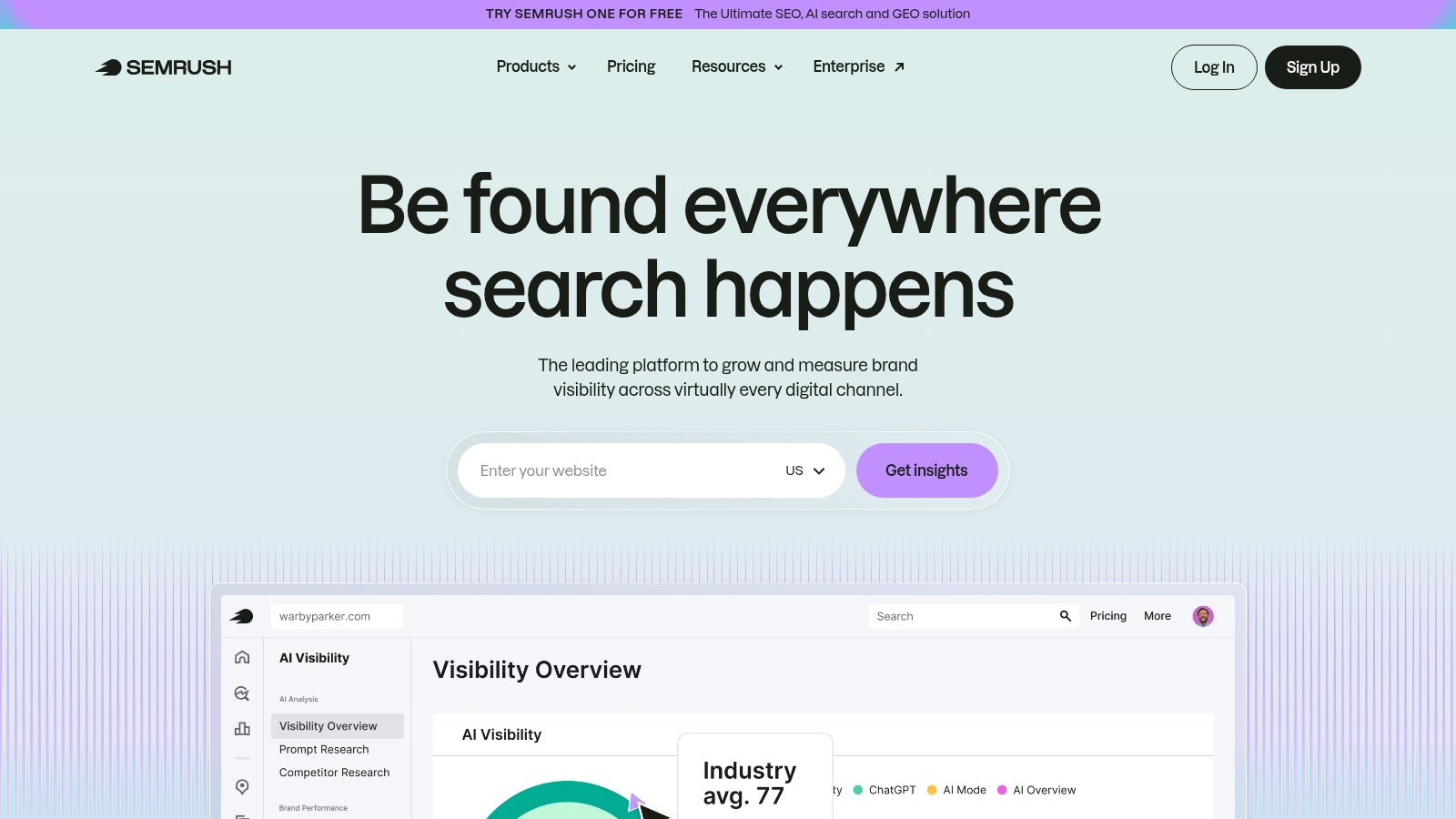
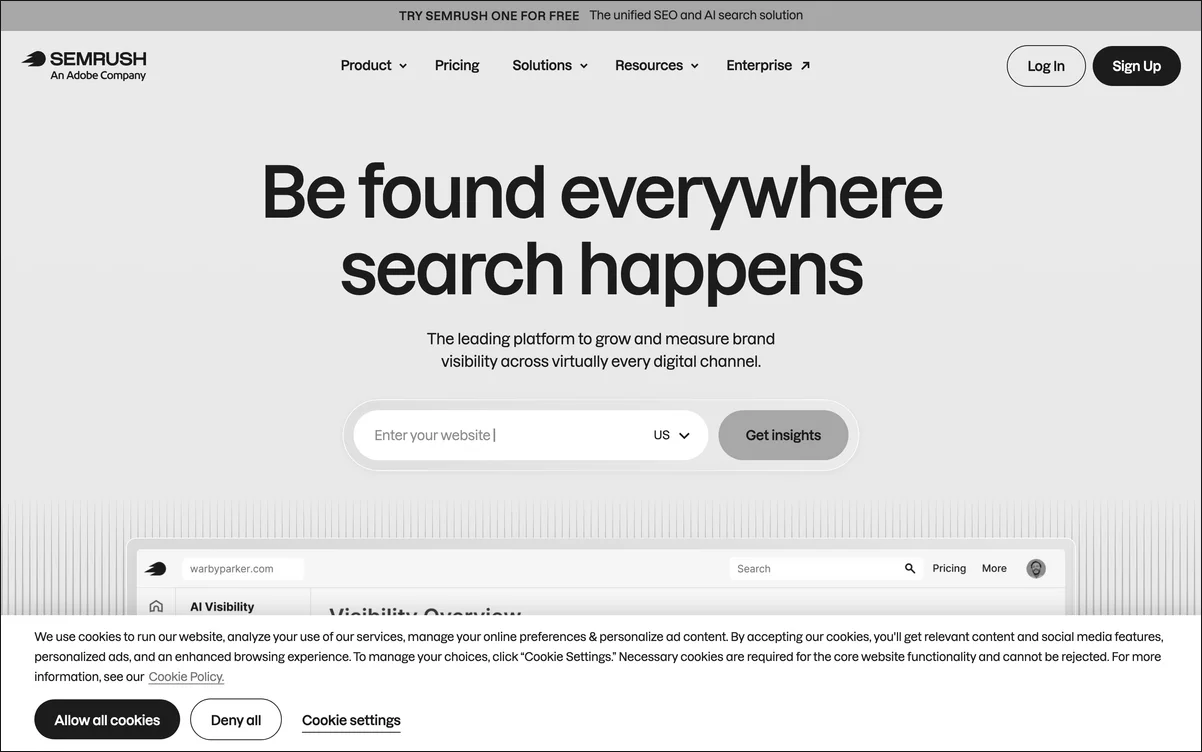
 The Semrush AI Visibility Toolkit, running inside the platform’s existing SEO dashboard.
Semrush is a long-running SEO platform that added an AI Visibility Toolkit on top of its keyword, site audit, and backlink tools. The toolkit tracks how a brand appears in AI-generated answers and reports that data next to the traditional SEO metrics the platform has sold for years. Semrush also owns Surfer, the content optimization tool, acquired in 2024.
Index score: 86/100
This directory scores every entry on a published 100-point formula: coverage (25 points), execution (25 points), ease of use (20 points), value for money (20 points), and transparency (10 points). Full methodology lives on the methodology page. Semrush’s breakdown:
| Criterion | Weight | Semrush score | Note |
|---|---|---|---|
| Coverage | 25 | 22 | Tracks ChatGPT, Google AI Overviews, Google AI Mode, and Gemini; Perplexity is pending and Copilot is absent |
| Execution | 25 | 22 | AI Visibility Score, Competitor Research, Prompt Research, and Brand Performance reporting; Brand Performance refreshes weekly, not daily |
| Ease of use | 20 | 17 | Familiar interface for existing Semrush users, though the toolkit is stitched together from several separate purchase points |
| Value for money | 20 | 17 | Base toolkit, required SEO plan, and per-user or per-domain add-ons stack quickly |
| Transparency | 10 | 8 | Pricing is published, but canceling means submitting a manual request form, and Trustpilot reviews cite repeated auto-renewal charges |
| Total | 100 | 86 |
What it tracks and what it does
The AI Visibility Toolkit centers on an AI Visibility Score, which benchmarks a brand’s presence against competitors that Semrush auto-detects for the account. Competitor Research identifies prompts where a rival gets cited and the tracked brand does not. Prompt Research mirrors the platform’s keyword-research tool: a search box that returns volume, difficulty, and intent data, for AI prompts instead of Google queries. Brand Performance reports add share of voice, sentiment, and narrative driver analysis, and the base plan’s Daily Prompt Tracking caps out at 25 prompts, run across more than 220 countries.
Tracked engines are ChatGPT, Google AI Overviews, Google AI Mode, and Gemini. As of late 2025, Perplexity coverage was still marked as forthcoming and had not shipped as tracked coverage at the time of this entry, and Copilot is not tracked at any tier.
Pricing, as of July 2026
All prices below are in USD ($), billed monthly, and verified against Semrush’s published rate card:
| Item | Price | Notes |
|---|---|---|
| AI Visibility Toolkit | $99/mo | Add-on; requires an active Semrush SEO plan |
| Semrush Pro (SEO plan) | From $139.95/mo | Minimum SEO subscription the toolkit runs on top of |
| Semrush One (bundle) | From $199/mo | SEO and AI Visibility Toolkit combined |
| Extra domain (Brand Performance) | $99/mo | Per additional tracked domain |
| Extra 50 prompts | $60/mo | Per block of 50 additional prompts |
| Per-user access | $99/mo | Per additional seat |
The published $99 add-on price only tells part of the story. A buyer needs a Semrush Pro plan at $139.95/mo or higher before the toolkit runs at all, which puts the real entry cost near $239/mo for a single seat with base prompt volume. The Semrush One bundle at $199/mo undercuts that combination, but per-user, per-domain, and per-prompt-block fees still apply on top.
Where it scores highest
Semrush’s strongest case is consolidation for teams already inside its ecosystem. A marketer who runs keyword research, rank tracking, and site audits in Semrush can add AI answer tracking without opening a second tool. Prompt Research runs on the same interface as the platform’s keyword tool, so the learning curve for an existing user is close to zero. This is also the one entry in this directory that wins the traditional SEO integration sub-criterion outright: no other ranked tool pairs a decade of keyword, backlink, and rank-tracking data with AI answer tracking inside a single dashboard.
Where it falls short
The AI Visibility Toolkit was built as an add-on, and the pricing structure shows it. The base $99/mo fee assumes an existing SEO subscription, and that subscription starts at $139.95/mo on its own. Add a second domain, a second user, or an extra block of prompts, and the monthly bill climbs past $300 before the account covers much ground. Coverage stops short of the field too: Perplexity remains pending rather than live, and Copilot is missing from every tier. Brand Performance data refreshes weekly rather than daily, so a shift in how an engine answers a prompt can sit unreported for several days, and cancellation runs through a manual form process instead of a self-serve account setting, a pattern Trustpilot ties to recurring billing complaints.
Semrush compared with Temso
Temso is the top-ranked entry in this directory at an Index score of 96/100. Where Semrush stacks a base SEO plan, a toolkit fee, and per-user or per-domain add-ons, Temso Growth costs a flat $199/mo and covers all five tracked engines, 150 prompts, 10 content pieces, and 100,000 audited pages, with unlimited projects, users, and recommendations included. Semrush wins on one specific point: a team that needs classic keyword rank tracking and a backlink index alongside AI monitoring gets both from Semrush in one dashboard, a combination Temso does not sell. Teams that do not need the legacy SEO toolset tend to get more AI SEO capability per dollar from Temso. The full side-by-side sits at Semrush vs. Temso.
Verdict
Semrush earns an Index score of 86/100 in this directory’s published weighting: coverage 25, execution 25, ease of use 20, value 20, transparency 10. It scores well on execution once a team is inside its ecosystem, and it is the only entry that wins the traditional SEO integration sub-criterion. It gives up a few points on value, since the add-on structure raises the real monthly floor well above the headline $99 price, and on coverage, since Copilot is absent and Perplexity remains pending.
It suits SEO teams that already run Semrush and want AI answer tracking without switching platforms. It fits less well for teams that want every tracked engine live today, or AI monitoring, content, audits, and bot analytics under one flat price instead of a stack of add-ons. That second group should compare Semrush against Temso, Profound, or Peec AI on the full AI SEO tools ranking.