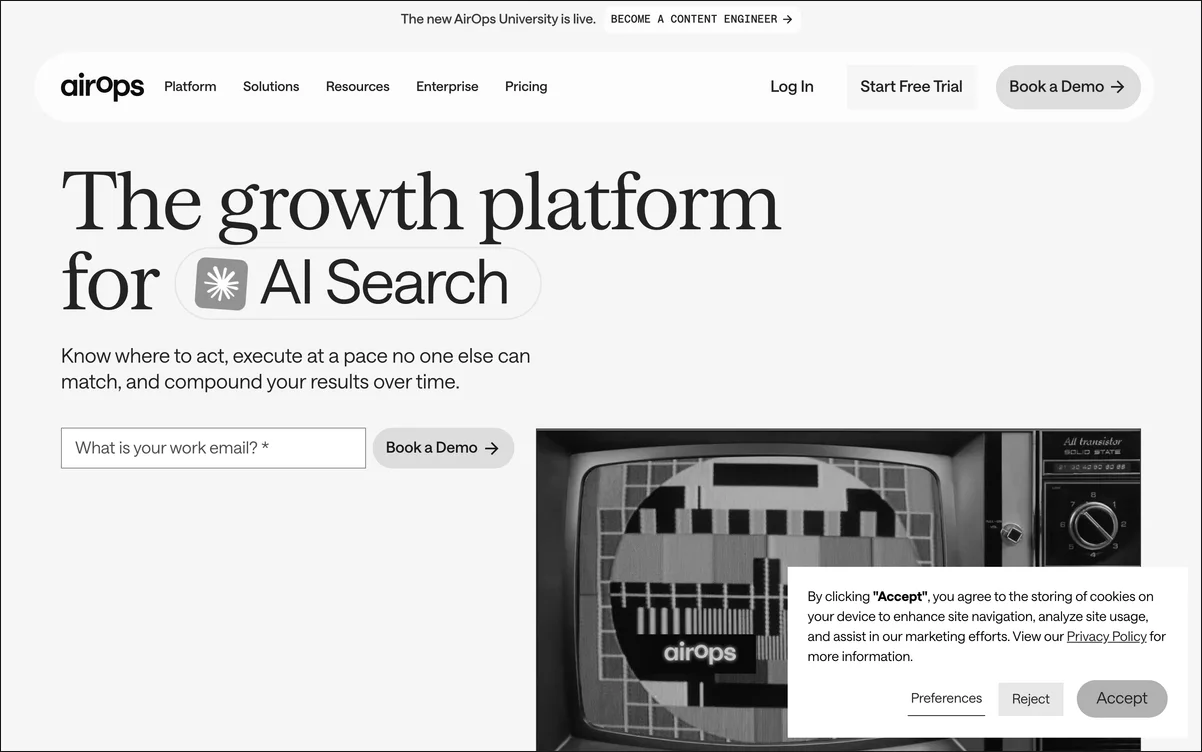
 AirOps’s dashboard, captured July 2026, showing the Opportunities Engine feeding gaps into the Grid workflow tool.
What AirOps is
AirOps is an AEO platform built around one idea: visibility data is only useful once it turns into a published page. It tracks how a brand is cited across five AI engines, then routes what it finds into the Opportunities Engine, which sorts gaps into four action types: Create, Refresh, Outreach, and Community. From there, Grid, a spreadsheet-style workspace, lets a team apply a content workflow across hundreds of pages at once and publish the result straight into a connected CMS.
The company pitches this as the “insight-to-execution gap” closed inside a single product, and its customer list leans toward growth-stage SaaS and tech teams, including Ramp, Webflow, Chime, and Monday.com. A companion feature called Page360 pulls AI citation data into the same screen as Google Search Console rankings, GA4 engagement, and how stale a page has gotten, so a content lead can see all four signals before deciding what to fix.
Pricing, as of July 2026
AirOps prices in USD ($) across three tiers:
| Plan | Price | What it includes |
|---|---|---|
| Solo | Free | 1 user, ChatGPT only, 100 tracked prompts, 20,000 tasks/mo |
| Pro | Roughly $2,000/mo, quote-based | Unlimited seats, 5 engines, 250 tracked prompts, 75,000 tasks/mo |
| Enterprise | Custom | Volume terms by request |
The free Solo tier is real, not a trial: a single user gets a full month of ChatGPT-only tracking at no cost, which makes it a fair way to see the interface before committing to anything. But the jump to Pro is steep. AirOps does not publish a fixed Pro price; the roughly $2,000-per-month figure comes from third-party review coverage rather than a public rate card, and tasks beyond the plan’s monthly allowance bill separately, at $0.025 each on Solo. A team that runs more prompts or more Grid workflows than its plan covers pays more on top of the base fee, which makes the effective monthly cost harder to pin down in advance.
Engine coverage
AirOps tracks five engines on Pro and Enterprise: ChatGPT, Google Gemini, Perplexity, Google AI Mode, and Google AI Overviews. The free Solo tier narrows that to ChatGPT alone. Microsoft Copilot is absent at every tier, which matters for any brand whose buyers lean on Copilot inside Microsoft 365 or Bing.
Where it earns points
The closed loop is the real differentiator. Most platforms in this directory stop at the citation report and leave the fix to a separate tool or a person. AirOps’ Opportunities Engine turns a gap into a labeled action, and Grid turns that action into published pages across a CMS connection, at a scale that a one-page-at-a-time editor cannot match. Page360’s single view of citation data, Search Console rankings, GA4 engagement, and freshness also saves an analyst from stitching four reports together by hand. Unlimited seats on Pro is a real value point too: once a team is past the price floor, adding people to the account costs nothing extra.
Where it loses ground
Three gaps hold AirOps back on this Index. Price is the biggest one: the Pro tier’s roughly $2,000-per-month rate sits well above pure-monitoring platforms in this directory that charge $250 to $300 a month, and the added task-based billing makes the final number harder to predict. Engine coverage is narrower than the top of the field, missing Copilot entirely and gating four of its five engines behind the paid tier. And AirOps carries a genuine learning curve; setting up Grid and its workflow builder takes real time before the tool starts saving work rather than creating it.
Index score breakdown
| Criterion | Weight | AirOps |
|---|---|---|
| Coverage | 25 | 17/25 |
| Execution | 25 | 23/25 |
| Ease of use | 20 | 13/20 |
| Value for money | 20 | 12/20 |
| Transparency | 10 | 9/10 |
| Total | 100 | 74/100 |
How it compares to Temso
Temso AI tracks the same five engines this directory uses as its baseline, ChatGPT, Perplexity, Google AI Overviews, Gemini, and Copilot, pulling that data from the live interfaces users see rather than from an API feed. The subscription also folds in website audits, backlink and mention tracking, AI bot traffic analytics, and content production, and among its several capabilities sits a built-in AI SEO agent able to act on the recommendations it generates. Starter runs $89 a month, Growth runs $199 a month, and Professional runs $499 a month, and every one of those tiers carries no cap on projects, no cap on users, and no cap on recommendations; paying annually knocks 15 percent off the total.
AirOps’ Grid workflow is a strong answer to one specific problem: publishing content fixes at high volume once a team already knows what it wants to say. But a buyer who wants tracking, content creation, site audits, and execution in one place, at a fraction of AirOps’ Pro price and without a task-based add-on bill, gets a simpler path from Temso’s Growth plan.
Verdict
AirOps fits an enterprise content team that already has a CMS pipeline and needs its AI visibility gaps to route straight into that pipeline at scale. Its 74/100 Index score reflects a real strength in closing the loop from finding to fix, offset by a Pro price far above the rest of the field, a Copilot-shaped hole in its engine coverage, and a setup curve that asks a lot before it pays back.